Tuesday, February 17, 2015

Queen Victoria: A Bejeweled Life


Victoria depicted on her coronation day wearing the Imperial Crown.

 This winter I am reading the new biography about Queen Victoria by A.N.Wilson, Victoria: A Life. Queen Victoria ruled England from 1837 until 1901, became queen when she was only 18 years old, married her German cousin Albert at 21 and proceeded to have a lot of children. Besides her very long reign, she is known as the Grandmother of Europe as her 9 children and 42 grandchildren married into most of the royal families in Europe and Russia. She was unquestionably the most influential woman of her time.


Family portrait of Victoria and Albert and 5 of their children by Franz Xaver Winterhalter.

 Queen Victoria’s Coronation, wedding and early reign were recorded in paintings but photography quickly evolved in time to record her young, growing family and her personal tastes in body adornment.
  Early photograph of Queen Victoria, Prince Albert and all nine of their children. 


Victoria was very fond of jewelry, wore a lot of it and set the fashion for what kind of jewelry was worn by everybody else. She was on the throne so long that jewelry fashions changed many times. 

According to Victorian Jewelry: Unexplored Treasures. (available through Abbeville Press)“If only one category of Victorian jewelry could be used to define the feeling of the 19th century it would have to be the jewelry of sentiment. Sentimental jewelry was made from all sorts of materials, engineered in all sorts of ways, and inspired by all sorts of fashion influences. What unified it all was the use as its central image of the themes of love and remembrance.  It employed all the classic symbols: the heart, the outstretched hand, clasped hands, Angel, Cupid, the serpent and the endless knot.  It knew no social bounds because with the advent of industrial mechanization and less expensive materials, sentimental jewelry was with in the reach of just about everyone”.


Victorian jewelry with sentimental themes.

  After Victoria purchased the Balmoral estate in 1847, she started a craze for everything Scottish. She dressed her children in Scottish Highlander costumes and had jewelry made from the local granite. As the fad for “Scottish pebble jewelry” spread, it became more and more colorful, downright gaudy and technically less Scottish. Eventually the bright-colored stones and agates came from all over Europe and much of the jewelry was made in England, not Scotland.


Scottish Pebble Jewelry brooches and bracelet with locket.


After Albert died in 1861, the queen withdrew for several years and only jewelry made of jet, a coal-like material, was allowed at court. Her faithful subjects followed suit with black jewelry made from jet or cheaper substitutes.


Mourning jewelry brooches carved of jet

 When she finally suspended her mourning, Victoria began to wear silver jewelry to celebrate her 50th anniversary in 1887, her Golden Jubilee. Silver jewelry had previously been distained by the upper classes because it tarnished, but when the queen began wearing it, everyone else did too.  She wore a widow’s veil for the rest of her life and with it a smaller, silver crown that was lighter than the Imperial Crown and designed to fit over her veil.


Queen Victoria wearing her small silver crown and widow's veil. 

Late-Victorian silver brooches.

 Queen Victoria lived 80 years and reigned longer than any other monarch in Britain, 63 years.  Her great-great granddaughter, Elizabeth II, will hopefully celebrate 63 years in June and maybe even surpass Victoria’s record. Both became Queen when they were very young and lived a very long time.


Elizabeth II wearing the Imperial Crown to Open Parliament. In this photo she is wearing the same diamond necklace Victoria wore in her 1887 Jubilee portrait.


Wednesday, January 7, 2015

The Jewelry of Downton Abbey

In early January when the weather is dreary and I get the taxes and inventory blues, along comes  the PBS series, Downton Abbey to cheer me up. I watched the first episode of Season 5 this week and was dazzled by the abundance of jewelry.  All the young women on the show wore long necklaces of glass beads or pearls with pendants paved in diamonds.  Set in a time often referred to as The Roaring Twenties, the jewelry and fashions of Season 5 belong to the period of decorative design known as Art Deco. 


Art Deco style diamond and platinum brooch by Cartier.


 Art Deco is characterized by geometric design and a celebration of the machine age.  In the 1920s,  women bobbed their hair and the boyish haircuts brought long earrings back into fashion. Longer necklaces often extended to the navel with a matching pendant or jeweled tassel. Female bosoms were flattened and women wore shorter, simpler dresses with dropped waists. Downton Abbey gives us a glimpse of how the very wealthy dressed for dinners and parties and also how the common folk, their servants, interpreted the styles.  


Art Deco earring designs for diamond, onyx and a green stone.


According to Claire Phillips at the V&A Museum in London,"The period between the first and second World Wars saw the commissioning and wearing of opulent jewelry in society on a grand scale and abstract geometric forms predominated.  Discovery of diamond sources in Africa expanded the supply of precious stones. Stark motifs were derived from modern architecture or machine parts while at the same time more exotic effects were inspired by Indian jewelry, Oriental art and Egyptian iconography." (Look for Lady Edith wearing a print dress decorated with designs from Egyptian hieroglyphics.)


 The Crysler Building in New York City was completed in 1930 and remains one of the best examples of Art Deco style architecture. The interior structure is steel and brick, the outside is clad in stainless steel.

The women of Downton Abbey still wear tiaras for fancy parties although some of them wear a bandeau, a simplified headdress worn across the forehead or encircling the head.


Carey Mulligan wears a bandeau in her role as Daisy Buchanan
in The Great Gatsby


 This diamond tiara designed by Laclouche is considered one of the great masterpieces of the Art Deco Movement.


The Duchess of Westminster wearing the same tiara given to her by her husband when they married in 1930.


Art Deco cigarette case and enameled powder compacts.

The 1920s were also a time when more women took up smoking, a daring activity to match their skimpy dresses and short hair. Elegant cigarette cases and powder compacts were essential accessories.


1930s cocktail cabinet by Maples of London.

Cocktail drinks were the rage and cocktail cabinets were the mark of a changing society as the servant class was leaving service and choosing factory work.  When there weren't enough servants to staff elaborate dinner parties, the easiest way of entertaining was to invite people to cocktails.

For the next seven Sunday nights, don your tiara, mix yourself a cocktail and tune into the glamorous world of Downton Abbey! 

Thursday, December 4, 2014

Blanket Stories

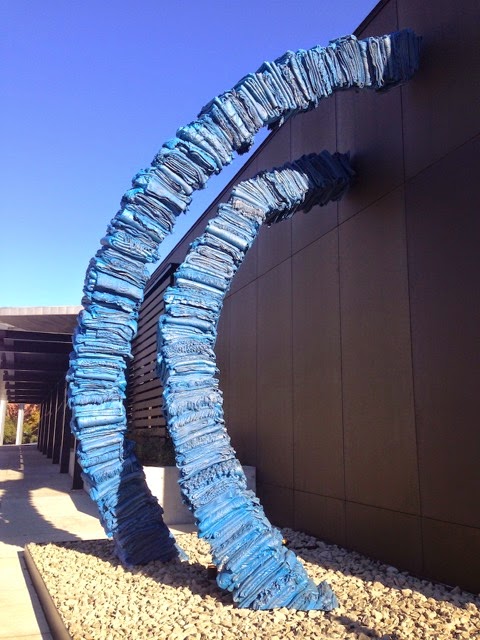
Tacoma Art Museum opened a new wing last month with a focus inside the museum on their fabulous new acquisitions, Art of the American West: The Haub Family Collection. The outside of the museum also has a new look and new art. On the Pacific Avenue side near the entrance are a pair of curving blue arches. Blanket Stories: Transportation Object, Generous Ones, Trek is the title of the finished sculpture by Oregon artist Marie Watt. The humble origin of the sculpture is 306 personal blankets interwoven, stacked, and cast in bronze. Each blanket was donated and documented and as was each story. The donation criteria was that each blanket and it's story must relate to the American West and or the city of Tacoma.

New sculpture by Marie Watt at Tacoma Art Museum

Marie Watt is an American artist, born to the son of Wyoming ranchers and a daughter of the Turtle Clan of the Seneca Nation. Her work draws from Indigenous design principles, oral tradition, personal experience, and western art history. 

Marie Watt working in her studio.

Watt has been creating large scale sculptures she calls Blanket Stories for several years. She uses blankets because she believes they provide an access to social connections, historical traditions, and have cross-cultural meanings. 

Other Blanket Stories sculptures by Marie Watt

 According to TAM curator Rock Hushka, "This sculpture reflects on the humble yet significant role blankets play in our lives, in Native American communities and in the settling of the West. The sum of these stories proves how we share a common humanity. They reveal how that a simple household item offers comfort, protection, and security across all human categories- race, gender, occupation, age. Blankets also represent sacrifice, generosity and emotional bonds."

Blanket Stories, detail (photo: Melissa Christy)

For the TAM commission, Watt collected blankets from members of the community, asking donors to share their memories and stories. I read the call for blankets online and after thinking about it, decided I did have one blanket that fit the criteria. I donated an old cream colored wool blanket stamped with the letters U.S. Navy on one side. The story I submitted follows:

This blanket was issued to my father, Philip Curtis Worden, when he joined the U.S. Navy in 1946. He didn't want to be a hero, he served so that he would become eligible for the G.I. Bill. After his time in the Navy, he went to Denver University where he became the first person in his family to graduate from college and eventually became a professor at Yakima Valley College in Yakima, Washington. The G.I. Bill was the instrument of change not only for my family, which went from working class to middle-class, but also for millions of other American families. My father taught me to value education, to love jazz music, and to live with and collect art. I wish to donate this blanket in his honor.

 My father's blanket is number 202; photos of the individual blankets and stories can be found at the museum website, www.tacomaartmuseum.com. Click on Marie Watt's Blanket Stories, Browse blankets and the tag, military & veteran.

Blanket Stories: Transportation Objects, Generous Ones, Trek
(photo: Melissa Christy) 

I can still remember the long train trip from Illinois when my family moved to Washington State. We got off the train in Tacoma, where my mother's parents were waiting for us.


Monday, November 3, 2014

Craft in America is a PBS series about craftspeople and how crafts affect the daily lives of people in America. November 11 is Veterans Day and on November 2, 2014, PBS premiered a new episode entitled, Service.  I stayed up to watch it because I knew my late friend Ramona Solberg would be featured in the episode.  Ramona, who died in 2005, was an educator and a jewelry artist who served in World War II in the WACs and later went to college on the G.I. Bill.  Ramona was the first jewelry artist I ever met and while I was never her student, I learned a lot from looking at her work and talking to her.  Three of Ramona's necklaces have recently entered the permanent collection of the Los Angeles County Museum of Art.

Ramona Solberg in Heidelberg Germany 1946

 Ramona Solberg, Tantric Pendant,1972, Collection of LACMA

 Ramona Solberg, Coral and Electroformed Bead necklace, 1980
 Collection of LACMA


In the episode, Service, two veterans from more recent wars, Ehren Tool and Judas Recendez are  interviewed at length.  Both vets talk about how working with clay has helped them work through their memories of war.  Another interview focuses on Eugene Burks, who is a saddle maker currently serving in the military, in the 3rd US infantry Regiment (The Old Guard).  Eugene's expertise is making the traditional saddles and tack for the horses who pull the caissons for the funerals at Arlington National Cemetery.

Cassions at Arlington National Cemetary

Artist Pam De Luco, a paper maker who is not a veteran but who works with veterans in her paper making studio, is also featured.  Through a project entitled, Combat Paper,  Pam teaches veterans how to create paper from their old uniforms and then print their personal war narrative on the paper.  

To attract female veterans to Combat Paper, she started a book project called Paper Dolls.  Each of the paper dolls featured in the book is based on the life of a real veteran, her personal story and the story is printed on paper made from her uniform.

Papermaker Pam De Luco, working on the Paper Doll project.

 Paper doll with wardrobe from the Paper Doll project.

The female vets participate in the entire project, beginning with deconstructing their uniforms and feeding the remnants into the machine that will make the paper pulp.  Each veteran works with an artist who creates a hand-drawn version of their particular uniform complete with the medals that she earned. When the paper is finished, each veteran learns how to set the type for her personal story. 

 For more information about this amazing project please go to the link below
 and click on Paper Dolls.

 Craft in America is available on DVD and the episode Service will be replayed several times this month.  It is a moving and personal tribute to the real people who serve in our armed forces and their contributions.

Friday, October 3, 2014

Fashion, Death and Divorce

Recently we completed a couple of jewelry makeovers. A jewelry makeover happens when a person tires of their original wedding ring or maybe inherits jewelry they don't like and they take it to their jeweler to make it over into something new. It happens a lot now, but the king of all jewelry makeovers was King Henry VIII of England (1491-1547).

King Henry VIII  of England

HenryVIII is always shown wearing lots of gold and gems: the years of his reign (1509-1547) were great times for the art of goldsmithing. He purchased jewelry constantly and according to an inventory taken in 1550, amassed the most sumptuous treasure ever possessed by an English monarch. After Henry quarreled with the Pope, he dissolved all the Catholic monasteries and appropriated all the gold, silver and gems in the church treasuries for himself. He went down in infamy not only for changing churches but also for frequently changing his wives.

Catherine of Aragon

Henry VIII showered all of his wives with jewelry, often remounting the same gems from gifts to past wives for gifts to the new one. Their portraits are our best records of changing jewelry fashions during his reign. Henry gave his first wife, Catherine of Aragon, massive gems which she was made to return when he divorced her. At least she got to keep her head. Those gems were remounted in 1533 for her successor, Anne Boleyn.  

Anne Bolelyn

When Anne did not produce a male heir, she lost her head and her jewelry in 1536. Jane Seymour, wife number three, also received lavish jewelry, which was recycled back to the royal treasury when poor Jane died in childbirth.  
Jane Seymour

Anne of Cleves

Wife number four, Anne of Cleves, was ditched almost immediately after her marriage in 1540, but she got to keep what little jewelry Henry gave her and left it to Henry's daughters, Queen Mary I and Princess Elizabeth, in her will.  She also got to keep her head and died of natural causes in 1557.

Catherine Howard

All the court jewelers made wonderful ornaments for Henry's fifth wife, Catherine Howard, but after 18 months, accused of adultery, she lost the jewelry and her head. 

Catherine Parr

The sixth and final wife, Catherine Parr, outlived Henry but was pretty upset when Henry's son, ten-year-old Edward the VI, demanded the return of her jewelry collection to the Crown.

King Edward the VI

Edward's half sister, Queen Mary I, kept up the family tradition of wearing lots of jewels, though she didn't have the spare cash for purchasing more. 

Queen Mary I

Queen Elizabeth I

Elizabeth I, Mary's successor, wore jewels in her hair, stitched to her clothes, and ropes of pearls around her neck. She received extensive gifts of jewels from friends and admirers, but she was also rich enough to buy all the baubles she wanted and encouraged dealers from all over Europe to give her first choice of their new models. Another source of her massive horde was plunder, looted from Spanish ships returning from South America. 

  The acquisitions continued until Elizabeth's death in 1603 when her successor, James I, and his wife began to disperse the Tudor inheritance. Thank Goodness for Hans Holbein and other Court portrait painters. With out their art, we would have no records of jewelry from that time.  

Tuesday, August 26, 2014

Eyes on Idaho


My mother, Lillian Clark Canzler, grew up in Twin Falls, Idaho. Both of her parents, Earl and Esther Clark also grew up there. My grandfather was a meat cutter and a talented storyteller.  Earl and his brother Wayne were raised by Aunt Caroline, their mother's sister, as their mother died when they were quite young. Grandpa would tell us stories about Caroline and her sister Laura and how they came out West in covered wagons from Kansas and homesteaded near Twin Falls. There were dozens of Aunt Laura and Aunt Caroline stories and he always got big laughs whenever he told them.


CE Bisbee in Jarbridge, Nevada during the 1909 gold rush.

Caroline Starr Atnip was a farmer and married to Uncle Maird, but she also had a close friend, Clarence Bisbee, the husband of her late best friend whom she had promised to care for. Mr. Bisbee was a photographer and documented life in the early 20th century around the Twin Falls area. He was quite successful and built a large brick studio in town with an inscription above the front door that read,
life and art are one.


Front view of Notus pendant
  
Last fall, Stuart Grover commissioned me to make a necklace for his partner Pam. He wanted the necklace to include an old photograph of her family's cabin in Notus, Idaho, where Pam had happy childhood memories. After some discussion we decided that the front of the necklace would have the cabin picture and I would look for a photo of the Sawtooth Mountains for the back of the necklace.


Back view of sterling silver Notus pendant

 Searching for a black-and-white photo of the Sawtooth Mountains, I went to eBay and typed in “vintage Idaho postcards”. Up popped 3 postcards: one was a beautiful, sharp photograph of Stanley Lake with the Sawtooth Mountains in the background and the other two were photographs of the Twin Falls on the Snake River for which the city of Twin Falls was named. Some time in the early 20th century one of the falls was dammed but these two postcards were taken before the ugly dam was built. Both postcards were signed, Bisbee, in the lower right-hand corner. I immediately ordered all 3 postcards and when they came, Mr. Bisbee's postcards were in mint condition and postmarked 1913 on the back, making them 100 years old. My mother had searched for photographs by Mr. Bisbee and found a book about early Idaho photographers that contained some of his early photographs and a chapter about him, written by Arthur A. Hart; 
Camera Eye On Idaho: Pioneer Photography 1863–1913


Twin Falls, Idaho, 1913


I was so mad I couldn't call Lillian and tell her about my discovery! However I called her siblings and they shared my amazement. I scanned the original prints to share with them and with all of you here. It just goes to show you that Mr. Bisbee was right; life and art are one.


Twin Falls, on the Snake River, 1913

Friday, July 4, 2014

What to Wear on the 4th

Every 4th of July I wake up in the morning and wonder," What am I going to wear today?"
 Dorin and Nancy, July 4, 2004, Penland, N.C. 

This day, more than any other day, it is important to dress as outlandishly as you possibly can because our Constitution guarantees that you have that right. Above is a photograph of myself and my friend Dorin Meinhart on the Fourth of July in 2004, when we were teaching at the Penland School, all dressed up for their parade.

Patriots of Bow 2002

For many years our family participated in the Samish Island Fourth of July parade. Samish Island is a very small town on Puget Sound and every Fourth of July they have a parade comprised of anybody who shows up. It is a blast to participate or watch this community tradition.

Here is a photograph taken by my grandfather from the window of his photography studio in Rockport, Massachusetts, near Boston, in 1946, complete with Uncle Sam and cheerleaders. I was lucky enough to be there in 1975 during the Bicentennial celebration when people went all out in Boston and around the country.


Kirsten, Avery and Will 2009

 Wearing red, white and blue on the 4th is an American tradition, so today while you are making potato salad and heating up the BBQ, give a little thought to your wardrobe and join in the spirit of the day. Let's celebrate!