Monday, May 23, 2016

The Whirligig Man

A long time ago I spent many hours driving around photographing folk environments. 
A folk environment is an art installation usually in the yard of someone's home created by an untrained, but passionate artist. Sometimes these artists are called outsider artists.


 In 1978, my friend Ken Cory and I drove to Coulee City to photograph the whirligigs of Emil Gherke. Emil had worked on the building of Grand Coulee Dam and he was a creative type. It can get pretty windy in that part of Washington, so he made whirligigs out of washing machine parts, old toys, vintage coffee pots and a lot of other things he picked up at rummage sales and thrift stores. He was amazing at coming up with combinations that would spin in the wind and were delightful to the eye. 


 At that time Mr. Gericke still lived in his little house, surrounded by his wonderful creations and a fence made of washing machine basins painted the colors of the rainbow. 


 Fortunately it was a gray day when we were there, so we weren't fighting dark shadows.
These images were shot with my favorite film, Kodachrome 64.
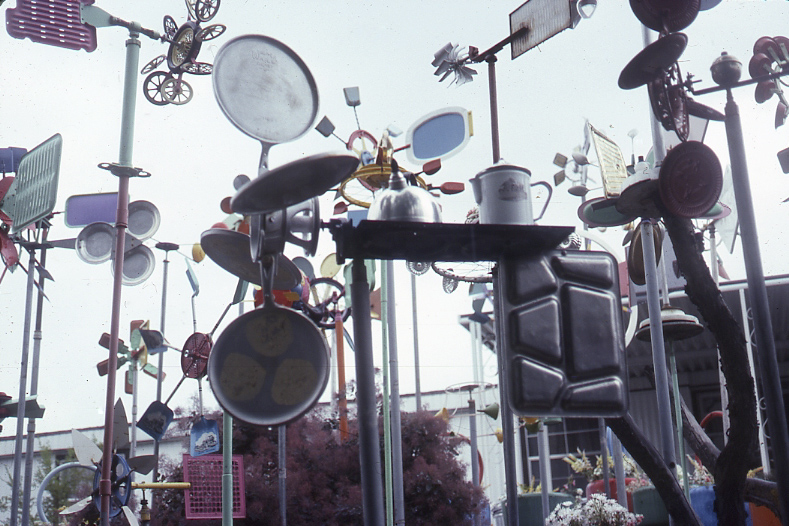

 11 years later I returned to the dam area but Mr. Gherke had passed away. They built a park near Lake Roosevelt with some of his whirligigs and I know that a few of them came to an electrical substation in Seattle. The whirligigs were still incredible even though they were surrounded by a cyclone fence instead of the  original washing machine fence.


There aren't as many folk environments around now because the people who built them aren't around. Most of the folk environments that I photographed were built by people of my grandparents generation.  These were people who grew up on farms and knew how to build things. They enjoyed creating a roadside attraction to attract tourists on road trips. Nowadays people travel to foreign countries in airplanes and they don't know how to make anything.  Has anyone seen the whirligigs at Lake Roosevelt recently? I would really like to know if they are still there.

Tuesday, March 22, 2016

Celebration of Color

It may be wet and gray outside but inside at the Seattle Art Museum there is a big celebration of color going on. The current exhibition, Kehinde Wiley: A New Republic, is one of the most inspiring painting shows I've seen at SAM in a long time.  Wiley creates enormous portraits of people he finds on the street, a process he calls street casting. Once he finds an interesting person, all people of color, he invites them to come to his studio for a photo session. The male subjects choose what they want to wear and a professional photographer captures them in poses related to famous portraits the artist finds in his large art history book collection.

Napoleon Leading the Army Over the Alps, 2005


 The history of painting by and large has pictured very few black and brown people, and in particular very few black men. My interest is in countering that absence.--Kehinde Wiley


The artist with his painting, Morpheus, from 2008

To quote the exhibition guide, "Kehinde Wiley lives and works in New York and Beijing. His work posits street culture, black masculinity, and the aesthetics of hip hop as constructs that obscure the complexity and subjectivity of human identity. Wiley exposes the familiar realm of portraiture to a host of questions. He asks us to notice how a subject's gestures, pose, dress and gaze communicate identity, class, power and authority. Folded within each portrait are more complex questions about European history and ideals of beauty as well as the history and legacy of colonialism. By inverting the blackbody into the classic poses of aristocratic individuals, religious fixed figures, and men of influence from the 15th to the early 20th centuries, Wiley's works appropriate and redefine a paradigm that has historically excluded young men of color. Originally focusing on male subjects the artist recently embarked on a series of striking images of women. All of Wiley's portraits celebrate his sitters. He challenges long-held assumptions by opening new doors of perception, offering unprecedented interpretations and reimagining the black figure is subject, object, and agent."


Randerson Romualdo Cordeiro 2008

While it is obvious Wiley is trying to change our perceptions, this work can also be enjoyed on a purely aesthetic level.  I can't remember the last time I saw such beautiful, rich figure painting and then to have it superimposed on backgrounds drenched in color and alive with decorative detail is an extra treat. The sheer size of these paintings is celebratory and it puts the predictable Photoshopped images that we see on the Internet and in magazines to shame.


Saint Gregory Palamas 2014

  This work glows, especially one whole room containing small portraits in gold leafed frames and painted stained-glass works lit from behind.  You don't have to know anything about art history or painting to appreciate this work, it is just downright gorgeous.

The Two Sisters, 2012, 96 x 72inches


An added feature in the exhibition is the film documentary, An Economy of Grace, which follows the process from the initial street encounters to the sitters reactions at first viewing the finished paintings.  The women subjects, most of whom work menial jobs, are transformed in contemporary couture gowns and wigs prepared by one of the top hairdressers in New York.  The film also includes shots of studio assistants at his Beijing studio painting in the elaborate backgrounds.  Wiley paints the figures and sets the stage and the assistants fill in the details.  How else could he be so prolific?
                                                                 I say more power to him.

Monday, October 12, 2015

Native Funk and Flash

Back in 1976 or 1977, I was walking through a bookstore in Yakima, Washington and stumbled on Native Funk and Flash: An Emerging Folk Art by Alexandra Jacopetti. It is a very unsophisticated celebration of home made fashion from an era when people embroidered imagery on their Levi's instead of tattooing their arms like they do now. I hung onto the book because it documented a time from my youth and it celebrated self-expression in a down home, folksy kind of way.

Pat Haines wearing the jacket she decorated.

I was pleasantly surprised to re-discover the book at the heart of a current exhibition
 showing at the Bellevue Arts Museum, 

Counter-Couture:Fashioning Identity in the American Counterculture, 
  

Counter-Couture is a celebration of the far out fashions from Native Funk & Flash, as well as clothes worn on stage by John Sebastian and Jimi Hendrix, big jewelry from that time and the influence of "hippie clothes" on the elite world of couture. 

Scrumbly, wearing his suit made from crocheted dollies.

 The guest curator, Michael Cepress, is a local clothing designer and an instructor at the University of Washington. He has developed a university course devoted to the history of style and fashion in the American counterculture of the 1960's and 1970's. He not only located some truly wonderful and amazing clothes for the exhibit he also interviewed many of the artists and learned their stories. 

Mary Ann Schildknecht wearing her prison project.

One of the more interesting stories is about Mary Ann Schildknecht, shown above. After traveling around Europe with her boyfriend, Mary Ann, then in her 20's, made the mistake of attempting to smuggle hashish onto a plane dressed like a hippie (red flag!) and was busted by Italian airport security. She was put in an Italian prison run by nuns and the nuns taught her how to embroider. 
She spent 18 months at the prison and created a very intricate blouse and skirt embroidered on fabric she stole from her bedsheets.
A very young Laurel Burch.

Another cool aspect of the book and show is the early work of artists who later became quite well known. Laurel Burch, who enjoyed enormous distribution of her designs in the 1980's and 1990's on tote bags, enameled jewelry, clothing and coffee cups, started out combining ethnic textiles to make interesting clothes for herself.  


Alex & Lee wearing their jewelry.

 Alex and Lee, partners in life and work, made heavily encrusted jewelry that later was picked up by Saks and I. Magnin. I remember seeing their samples at apparel shows in the 80's.

Some of my favorite clothes in the show were created by Kasik Wong. His clothing is beautifully constructed, nothing funky about it, and could easily serve as theatrical costume.

Kaisik Wong wearing one of his jackets and hat.

The show is up through January 10. On Saturdays and Sundays you will need to park and walk to the museum as the street in front of the building will be blocked for construction. 
It's worth it, this is a fun show.

Monday, July 27, 2015

THINK SMART, THINK SLOW

Mantle for Textual Assault, 2015, Steel, brass, copper, aluminum, gold leaf, found objects.


 For a couple of years I’ve been reading articles about an uptick in hostility by way of electronic messaging. Politicians and celebrities send lewd photos or hateful texts, forgetting how easily they can be retrieved and used against them. Students tap out hostile twitters about the professor to other students in class, but it’s OK if no one gets caught. We say things in a text or an email that we would never say to someone’s face. Politeness, respect and etiquette have gone the way of privacy and state secrets. 

Mantle for Textual Assault, Reverse, 2015. 

 Sherry Turkle is a psychologist at MIT who has been studying the effects of electronic communication on human relationships since the 1970’s. She wrote a book, Alone Together, describing her research that I found very depressing. Her TED talk is easier to digest and this quote says it all:

“We fear the risks and disappointments
of relationships with our fellow humans.
We expect more from technology and less from each other.”

Turkle is concerned that people are becoming dependant on their devices for company and are forgetting or not even learning the value of engaging with other people face-to-face. Here is a quote from an 18-year-old male she interviewed in her research:

“Someday, someday, but certainly not now,
I would like to learn how to have a conversation.”


Mantle for Textual Assault, 2015, shown on steel stand.

Distilling my thoughts on this cultural challenge into a piece of jewelry was very difficult. I chose to use steel chain mail in an armor situation, thinking it would be lightweight and easy to wear. My design influences began with historical chain mail worn by foot soldiers in Medieval Europe combined with Tudor era plate armor and a nod to 18th century military uniforms. Then I progressed towards Edwardian handbags and the drippy, bugle-bead-encrusted-dresses worn on Downton Abbey. I hung it all off a heavy wool felt base for flexibility. A mantle is an old word for a shawl or cape.
Steel chain mail hauberk or coat, Western European, 16th century.
"Mail is a network of interlocking iron or steel and occasionally brass rings whose density and tight construction created a surface resistant to the sharp edges of cutting weapons."
Arms And Armor in the Art Institute of Chicago.

Stamped and die formed aluminum and steel chain mail.

The icing on the cake was stamping the epaulette-like shoulders with Turkle quotes and NetLingo, the new language evolving from texting. (You can actually buy a NetLingo dictionary!)


Detail of Reverse.

My goal is to empower the wearer with authority and fortitude and combine it with a message of temperance to deflect textual assault. THINK SMART before sending a message and THINK SLOW to insure your message is one you won’t later regret. Now if I can just learn to follow my own advice.

Wednesday, May 13, 2015

Fun Jewelry Shows in Bellevue


There are currently two fun jewelry shows at the Bellevue Arts Museum.

Read my Pins: The Madeleine Albright Collection has been getting abundant publicity, but if you haven’t seen it yet the last day is June 7 and it’s worth the trip.


Madeline Albright wearing brooch by Dutch artist Gijs Bakker 

  Secretary Albright was in town in March and spoke at a couple of fundraisers for the museum.  I was lucky enough to hear her speak at Bellevue City Hall. She is a good storyteller and has lived the kind of life that provides good stories.  I also recommend the book that accompanies the exhibit. It is worth the money as it includes the stories and photographs of her wearing the jewelry collection in real life scenarios, such as with the pair of images below. 


Bee brooch, designer unknown

Sec. Albright working with Yasser Arafat wearing the bee.

 What surprised me most about seeing her pins in person was the size of them. Many of the brooches are quite large, and some of them are downright garish and would qualify as bling.  Albright’s collection is made up of one-of-a-kind art pieces, exquisite antiques, inexpensive costume jewelry, and even a little ceramic heart created by her youngest daughter when she was five years old. She tends to collect themes; patriotic icons, birds, animals and insects, flowers and leaves, shells and fish as well as classic fine jewelry with beautiful stones and cutesy stuff like high-heeled shoes, cowboy hats and Mickey Mouse. In other words it’s a little bit of everything and she wears it all.


Hear No Evil, Speak No Evil, See No Evil, by Iradj Moini

Clowning around with Defense Sec. Cohen and President Clinton.

 What makes this particular collection special is that Albright has used her jewelry as a way to communicate while engaged in international diplomacy. She uses it the same way that I often use my jewelry, which is to start a conversation with people.


With Nelson Mandela in 1997, wearing her zebra brooch.

Madeline Albright was the first female US Secretary of State and she didn't have a wife to pack her bags for her many trips. She packed clothes that didn't wrinkle (St. Johns suits) and a selection of jewelry for any occasion. She also packed her cowboy hat to wear on bad hair days. I wonder, does John Kerry ever worry about that? 


Some of the pins were gifts, such as this peace dove that was given to her by Leah Rabin, widow of Israeli Prime Minister Rabin.


 Upstairs from the Albright exhibit is 
Jana Brevick: This Infinity Fits in My Hand, up through August 16, 2015.

Puzzle Guts, from the robot series


Jana is the daughter of an engineer and grew up in a family that moved to wherever her father's projects were. Much of the work is a celebration of an older mechanical world, one of robots and dials and tiny satellites. 

From the Intermittent Series

As the granddaughter and wife of engineers, I understand this fascination with old vacuum tubes, mica, detailed diagrams and machines that have real buttons to push. Obsolete electronic parts look very much like jewelry in this their scale and delicate constructions.


Whirl


 Jana sometimes uses the actual parts in jewelry like these little fans she used in the necklace, Whirl, and sometimes focuses on their forms, such as in her cast iron ring series, Transmitters.


Transmitters


My favorite in the whole show is a necklace with tiny delicate satellite shapes titled, Listening…


Listening.... necklace


In one corner of the installation, Jana and her husband created the Atomic Ex-filtrator Ship 7, a sort of spaceship environment for viewing larger jewelry pieces and un-wearable sculptures. The Atomic Ex-filtrator creates an atmosphere kind of like interactive displays at a science museum and adds a feeling of playfulness to the explorations in the show. 

I think Jana's intent is to get us to think a little bit but she also wants her audience to have some fun while thinking.

Friday, March 20, 2015

Middle Fork

Recently I was feeling stuck on a project and overwhelmed with the annual ritual of tax returns.  I decided that what I needed was a strong shot of good art. I had read in the paper about an interesting sculpture being assembled near Lake Union at MadArt, a new non-profit art space, so on a Saturday morning I headed off to find it.


Looking into the base and through the form of Middle Fork sculpture by artist John Grade

 Thank goodness my cell phone has a good camera so I can share John Grade's Middle Fork with you. Middle Fork consists of thousands of tiny blocks of repourposed cedar carefully cut by hand and glued together over a plaster cast of a living tree. The cast was made by covering the standing tree, section by section first with aluminum foil and then with cheesecloth dipped in plaster. Grade and his assistants literally hung by ropes during the two weeks it took to cast the 140 year old hemlock tree near North Bend, Washington. For more images of the process, check out this link: http://madartseattle.com/exhibits/middle-fork/

 Lower section of Middle Fork

Upper section of Middle Fork
In this image you can see the many stainless steel cables that suspend the 700 pound sculpture.

The gluing process, which is still going on, was accomplished over several months with hundreds of volunteers who carefully fit each tiny block of cedar, all approximately 1/4 thick, to fit over  sections of the plaster cast of the tree. 

Detail of glueing process. Notice the spaces between the tiny cedar blocks. 

Detail of branches suspended.

After glueing, the entire surface of the sculpture was sanded smooth inside and out. The individual sections were then suspended by steel cables to form a see-through horizontal tree. The effect of so many stacked blocks with spaces in between is of weightless wood lace. The whole form, about as long as 3 minivans, appears to breathe as if it were alive. The variations in wood color and patterns add to the overall beauty. Standing next to and walking around the sculpture so that you can see into and through the form is the best way to relate to the scale and appreciate the enormity and delicacy of Middle Fork.

Looking inside the huge base. 

Enhancing the whole experience of the piece is a video chronicling the construction process.
Middle Fork will leave Seattle soon to travel to London, Hong Kong and the Renwick Gallery of the Smithsonian. After two years on the road, Grade will lie it on the ground near the original tree and watch it moss over and fall apart over time, continuing this conversation with Nature.

Looking through the base toward the top.


There isn't much more time to see this amazing structure in Seattle. It is only up through April 25. MadArt is open Wednesday-Saturday 11-5 or by appointment. The address is 329 Westlake, on the west side of the street, north of Whole Foods and south of Republican. Don't miss this one.

Tuesday, February 17, 2015

Queen Victoria: A Bejeweled Life


Victoria depicted on her coronation day wearing the Imperial Crown.

 This winter I am reading the new biography about Queen Victoria by A.N.Wilson, Victoria: A Life. Queen Victoria ruled England from 1837 until 1901, became queen when she was only 18 years old, married her German cousin Albert at 21 and proceeded to have a lot of children. Besides her very long reign, she is known as the Grandmother of Europe as her 9 children and 42 grandchildren married into most of the royal families in Europe and Russia. She was unquestionably the most influential woman of her time.


Family portrait of Victoria and Albert and 5 of their children by Franz Xaver Winterhalter.

 Queen Victoria’s Coronation, wedding and early reign were recorded in paintings but photography quickly evolved in time to record her young, growing family and her personal tastes in body adornment.
  Early photograph of Queen Victoria, Prince Albert and all nine of their children. 


Victoria was very fond of jewelry, wore a lot of it and set the fashion for what kind of jewelry was worn by everybody else. She was on the throne so long that jewelry fashions changed many times. 

According to Victorian Jewelry: Unexplored Treasures. (available through Abbeville Press)“If only one category of Victorian jewelry could be used to define the feeling of the 19th century it would have to be the jewelry of sentiment. Sentimental jewelry was made from all sorts of materials, engineered in all sorts of ways, and inspired by all sorts of fashion influences. What unified it all was the use as its central image of the themes of love and remembrance.  It employed all the classic symbols: the heart, the outstretched hand, clasped hands, Angel, Cupid, the serpent and the endless knot.  It knew no social bounds because with the advent of industrial mechanization and less expensive materials, sentimental jewelry was with in the reach of just about everyone”.


Victorian jewelry with sentimental themes.

  After Victoria purchased the Balmoral estate in 1847, she started a craze for everything Scottish. She dressed her children in Scottish Highlander costumes and had jewelry made from the local granite. As the fad for “Scottish pebble jewelry” spread, it became more and more colorful, downright gaudy and technically less Scottish. Eventually the bright-colored stones and agates came from all over Europe and much of the jewelry was made in England, not Scotland.


Scottish Pebble Jewelry brooches and bracelet with locket.


After Albert died in 1861, the queen withdrew for several years and only jewelry made of jet, a coal-like material, was allowed at court. Her faithful subjects followed suit with black jewelry made from jet or cheaper substitutes.


Mourning jewelry brooches carved of jet

 When she finally suspended her mourning, Victoria began to wear silver jewelry to celebrate her 50th anniversary in 1887, her Golden Jubilee. Silver jewelry had previously been distained by the upper classes because it tarnished, but when the queen began wearing it, everyone else did too.  She wore a widow’s veil for the rest of her life and with it a smaller, silver crown that was lighter than the Imperial Crown and designed to fit over her veil.


Queen Victoria wearing her small silver crown and widow's veil. 

Late-Victorian silver brooches.

 Queen Victoria lived 80 years and reigned longer than any other monarch in Britain, 63 years.  Her great-great granddaughter, Elizabeth II, will hopefully celebrate 63 years in June and maybe even surpass Victoria’s record. Both became Queen when they were very young and lived a very long time.


Elizabeth II wearing the Imperial Crown to Open Parliament. In this photo she is wearing the same diamond necklace Victoria wore in her 1887 Jubilee portrait.