Thursday, December 4, 2014

Blanket Stories

Tacoma Art Museum opened a new wing last month with a focus inside the museum on their fabulous new acquisitions, Art of the American West: The Haub Family Collection. The outside of the museum also has a new look and new art. On the Pacific Avenue side near the entrance are a pair of curving blue arches. Blanket Stories: Transportation Object, Generous Ones, Trek is the title of the finished sculpture by Oregon artist Marie Watt. The humble origin of the sculpture is 306 personal blankets interwoven, stacked, and cast in bronze. Each blanket was donated and documented and as was each story. The donation criteria was that each blanket and it's story must relate to the American West and or the city of Tacoma.

New sculpture by Marie Watt at Tacoma Art Museum

Marie Watt is an American artist, born to the son of Wyoming ranchers and a daughter of the Turtle Clan of the Seneca Nation. Her work draws from Indigenous design principles, oral tradition, personal experience, and western art history. 

Marie Watt working in her studio.

Watt has been creating large scale sculptures she calls Blanket Stories for several years. She uses blankets because she believes they provide an access to social connections, historical traditions, and have cross-cultural meanings. 

Other Blanket Stories sculptures by Marie Watt

 According to TAM curator Rock Hushka, "This sculpture reflects on the humble yet significant role blankets play in our lives, in Native American communities and in the settling of the West. The sum of these stories proves how we share a common humanity. They reveal how that a simple household item offers comfort, protection, and security across all human categories- race, gender, occupation, age. Blankets also represent sacrifice, generosity and emotional bonds."

Blanket Stories, detail (photo: Melissa Christy)

For the TAM commission, Watt collected blankets from members of the community, asking donors to share their memories and stories. I read the call for blankets online and after thinking about it, decided I did have one blanket that fit the criteria. I donated an old cream colored wool blanket stamped with the letters U.S. Navy on one side. The story I submitted follows:

This blanket was issued to my father, Philip Curtis Worden, when he joined the U.S. Navy in 1946. He didn't want to be a hero, he served so that he would become eligible for the G.I. Bill. After his time in the Navy, he went to Denver University where he became the first person in his family to graduate from college and eventually became a professor at Yakima Valley College in Yakima, Washington. The G.I. Bill was the instrument of change not only for my family, which went from working class to middle-class, but also for millions of other American families. My father taught me to value education, to love jazz music, and to live with and collect art. I wish to donate this blanket in his honor.

 My father's blanket is number 202; photos of the individual blankets and stories can be found at the museum website, www.tacomaartmuseum.com. Click on Marie Watt's Blanket Stories, Browse blankets and the tag, military & veteran.
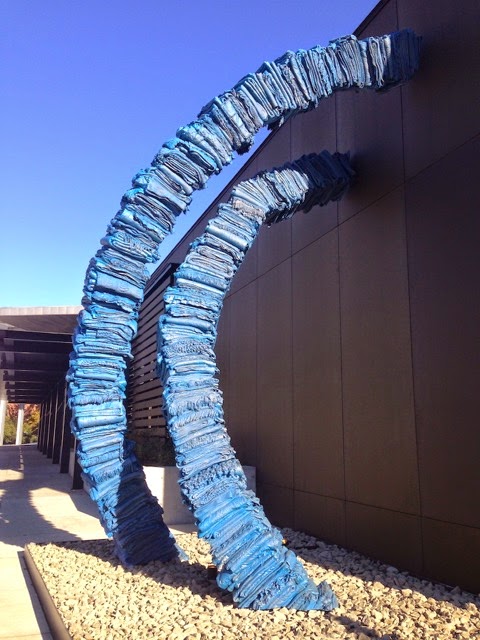
Blanket Stories: Transportation Objects, Generous Ones, Trek
(photo: Melissa Christy) 

I can still remember the long train trip from Illinois when my family moved to Washington State. We got off the train in Tacoma, where my mother's parents were waiting for us.


Monday, November 3, 2014

Craft in America is a PBS series about craftspeople and how crafts affect the daily lives of people in America. November 11 is Veterans Day and on November 2, 2014, PBS premiered a new episode entitled, Service.  I stayed up to watch it because I knew my late friend Ramona Solberg would be featured in the episode.  Ramona, who died in 2005, was an educator and a jewelry artist who served in World War II in the WACs and later went to college on the G.I. Bill.  Ramona was the first jewelry artist I ever met and while I was never her student, I learned a lot from looking at her work and talking to her.  Three of Ramona's necklaces have recently entered the permanent collection of the Los Angeles County Museum of Art.

Ramona Solberg in Heidelberg Germany 1946

 Ramona Solberg, Tantric Pendant,1972, Collection of LACMA

 Ramona Solberg, Coral and Electroformed Bead necklace, 1980
 Collection of LACMA


In the episode, Service, two veterans from more recent wars, Ehren Tool and Judas Recendez are  interviewed at length.  Both vets talk about how working with clay has helped them work through their memories of war.  Another interview focuses on Eugene Burks, who is a saddle maker currently serving in the military, in the 3rd US infantry Regiment (The Old Guard).  Eugene's expertise is making the traditional saddles and tack for the horses who pull the caissons for the funerals at Arlington National Cemetery.

Cassions at Arlington National Cemetary

Artist Pam De Luco, a paper maker who is not a veteran but who works with veterans in her paper making studio, is also featured.  Through a project entitled, Combat Paper,  Pam teaches veterans how to create paper from their old uniforms and then print their personal war narrative on the paper.  

To attract female veterans to Combat Paper, she started a book project called Paper Dolls.  Each of the paper dolls featured in the book is based on the life of a real veteran, her personal story and the story is printed on paper made from her uniform.

Papermaker Pam De Luco, working on the Paper Doll project.

 Paper doll with wardrobe from the Paper Doll project.

The female vets participate in the entire project, beginning with deconstructing their uniforms and feeding the remnants into the machine that will make the paper pulp.  Each veteran works with an artist who creates a hand-drawn version of their particular uniform complete with the medals that she earned. When the paper is finished, each veteran learns how to set the type for her personal story. 

 For more information about this amazing project please go to the link below
 and click on Paper Dolls.

 Craft in America is available on DVD and the episode Service will be replayed several times this month.  It is a moving and personal tribute to the real people who serve in our armed forces and their contributions.

Friday, October 3, 2014

Fashion, Death and Divorce

Recently we completed a couple of jewelry makeovers. A jewelry makeover happens when a person tires of their original wedding ring or maybe inherits jewelry they don't like and they take it to their jeweler to make it over into something new. It happens a lot now, but the king of all jewelry makeovers was King Henry VIII of England (1491-1547).

King Henry VIII  of England

HenryVIII is always shown wearing lots of gold and gems: the years of his reign (1509-1547) were great times for the art of goldsmithing. He purchased jewelry constantly and according to an inventory taken in 1550, amassed the most sumptuous treasure ever possessed by an English monarch. After Henry quarreled with the Pope, he dissolved all the Catholic monasteries and appropriated all the gold, silver and gems in the church treasuries for himself. He went down in infamy not only for changing churches but also for frequently changing his wives.

Catherine of Aragon

Henry VIII showered all of his wives with jewelry, often remounting the same gems from gifts to past wives for gifts to the new one. Their portraits are our best records of changing jewelry fashions during his reign. Henry gave his first wife, Catherine of Aragon, massive gems which she was made to return when he divorced her. At least she got to keep her head. Those gems were remounted in 1533 for her successor, Anne Boleyn.  

Anne Bolelyn

When Anne did not produce a male heir, she lost her head and her jewelry in 1536. Jane Seymour, wife number three, also received lavish jewelry, which was recycled back to the royal treasury when poor Jane died in childbirth.  
Jane Seymour

Anne of Cleves

Wife number four, Anne of Cleves, was ditched almost immediately after her marriage in 1540, but she got to keep what little jewelry Henry gave her and left it to Henry's daughters, Queen Mary I and Princess Elizabeth, in her will.  She also got to keep her head and died of natural causes in 1557.

Catherine Howard

All the court jewelers made wonderful ornaments for Henry's fifth wife, Catherine Howard, but after 18 months, accused of adultery, she lost the jewelry and her head. 

Catherine Parr

The sixth and final wife, Catherine Parr, outlived Henry but was pretty upset when Henry's son, ten-year-old Edward the VI, demanded the return of her jewelry collection to the Crown.

King Edward the VI

Edward's half sister, Queen Mary I, kept up the family tradition of wearing lots of jewels, though she didn't have the spare cash for purchasing more. 

Queen Mary I

Queen Elizabeth I

Elizabeth I, Mary's successor, wore jewels in her hair, stitched to her clothes, and ropes of pearls around her neck. She received extensive gifts of jewels from friends and admirers, but she was also rich enough to buy all the baubles she wanted and encouraged dealers from all over Europe to give her first choice of their new models. Another source of her massive horde was plunder, looted from Spanish ships returning from South America. 

  The acquisitions continued until Elizabeth's death in 1603 when her successor, James I, and his wife began to disperse the Tudor inheritance. Thank Goodness for Hans Holbein and other Court portrait painters. With out their art, we would have no records of jewelry from that time.  

Tuesday, August 26, 2014

Eyes on Idaho


My mother, Lillian Clark Canzler, grew up in Twin Falls, Idaho. Both of her parents, Earl and Esther Clark also grew up there. My grandfather was a meat cutter and a talented storyteller.  Earl and his brother Wayne were raised by Aunt Caroline, their mother's sister, as their mother died when they were quite young. Grandpa would tell us stories about Caroline and her sister Laura and how they came out West in covered wagons from Kansas and homesteaded near Twin Falls. There were dozens of Aunt Laura and Aunt Caroline stories and he always got big laughs whenever he told them.


CE Bisbee in Jarbridge, Nevada during the 1909 gold rush.

Caroline Starr Atnip was a farmer and married to Uncle Maird, but she also had a close friend, Clarence Bisbee, the husband of her late best friend whom she had promised to care for. Mr. Bisbee was a photographer and documented life in the early 20th century around the Twin Falls area. He was quite successful and built a large brick studio in town with an inscription above the front door that read,
life and art are one.


Front view of Notus pendant
  
Last fall, Stuart Grover commissioned me to make a necklace for his partner Pam. He wanted the necklace to include an old photograph of her family's cabin in Notus, Idaho, where Pam had happy childhood memories. After some discussion we decided that the front of the necklace would have the cabin picture and I would look for a photo of the Sawtooth Mountains for the back of the necklace.


Back view of sterling silver Notus pendant

 Searching for a black-and-white photo of the Sawtooth Mountains, I went to eBay and typed in “vintage Idaho postcards”. Up popped 3 postcards: one was a beautiful, sharp photograph of Stanley Lake with the Sawtooth Mountains in the background and the other two were photographs of the Twin Falls on the Snake River for which the city of Twin Falls was named. Some time in the early 20th century one of the falls was dammed but these two postcards were taken before the ugly dam was built. Both postcards were signed, Bisbee, in the lower right-hand corner. I immediately ordered all 3 postcards and when they came, Mr. Bisbee's postcards were in mint condition and postmarked 1913 on the back, making them 100 years old. My mother had searched for photographs by Mr. Bisbee and found a book about early Idaho photographers that contained some of his early photographs and a chapter about him, written by Arthur A. Hart; 
Camera Eye On Idaho: Pioneer Photography 1863–1913


Twin Falls, Idaho, 1913


I was so mad I couldn't call Lillian and tell her about my discovery! However I called her siblings and they shared my amazement. I scanned the original prints to share with them and with all of you here. It just goes to show you that Mr. Bisbee was right; life and art are one.


Twin Falls, on the Snake River, 1913

Friday, July 4, 2014

What to Wear on the 4th

Every 4th of July I wake up in the morning and wonder," What am I going to wear today?"
 Dorin and Nancy, July 4, 2004, Penland, N.C. 

This day, more than any other day, it is important to dress as outlandishly as you possibly can because our Constitution guarantees that you have that right. Above is a photograph of myself and my friend Dorin Meinhart on the Fourth of July in 2004, when we were teaching at the Penland School, all dressed up for their parade.

Patriots of Bow 2002

For many years our family participated in the Samish Island Fourth of July parade. Samish Island is a very small town on Puget Sound and every Fourth of July they have a parade comprised of anybody who shows up. It is a blast to participate or watch this community tradition.

Here is a photograph taken by my grandfather from the window of his photography studio in Rockport, Massachusetts, near Boston, in 1946, complete with Uncle Sam and cheerleaders. I was lucky enough to be there in 1975 during the Bicentennial celebration when people went all out in Boston and around the country.


Kirsten, Avery and Will 2009

 Wearing red, white and blue on the 4th is an American tradition, so today while you are making potato salad and heating up the BBQ, give a little thought to your wardrobe and join in the spirit of the day. Let's celebrate!


Monday, June 16, 2014

Woman vs Nature

It's that time of year when there are just enough nice days to start contemplating outdoor home repairs. I'd like to tell you that when I'm in my studio I think about the meaning of the universe and other lofty thoughts, but the truth is what I've been thinking about lately is new gutters and Drainage. My studio is in an elderly building, 94 years old, and every year when it's dry outside I try to prepare for the winter to come. I have French drains under the building, French drains around the building, and a system of grilled drains around the lot that channel rainwater into a collection box and then out to the city sewer line.
Ambition Foiled, Nancy Worden 2011

The fall of 2010 I was feeling especially smug because I had the new outdoor drains. When the first winter storm hit and the basement at the studio flooded I was angry and confused. The culprit that year was tree roots in the sewer line, something insurance companies refuse to cover. The plumbers that responded to my rescue sent out a very calm and experienced individual who explained to me it was going to cost $1000 a foot to fix my sewer line. It took awhile to sink in, but eventually I asked, "Do you take Visa?"  The experience inspired the wall collar pictured above. We gold leafed the entire frame and added some glass eyeballs to ward off evil spirits. It hangs on the wall near the door of our house to remind me that in any contest between Woman and Nature, Nature will always be the winner.

Today I went online to view the public art collection owned by the City of Seattle, especially the work commissioned by Seattle Public Utilities and Seattle City Light. They have commissioned 31  permanent site art projects and a third of those are about or in some way deal with water.  Below are some of my favorites, find their locations via the link.

Chimera, Ted Jonsson 1975

Raven Shouts Water, Barbara Earl Thomas 2001

 Beckoning Cistern, Buster Simpson 2002

Waterworks, Douglas Hollis 2005

Tuesday, May 6, 2014

New Growth

It's that time of year when the trees are budding and we are celebrating new growth.  Once upon a time I made a neckpiece that looks like an overgrown silver vine with little 14K gold ears sprouting from it.  The title of this artwork is Grafting, and for those who grew up in the Yakima Valley amongst apple orchards "grafting" refers to a method of attaching branches of different varieties to a rootstock to make a unique and healthy tree.  On one shoulder there is also something that looks like a gold walnut that is actually a small brain. The idea came to me after I read an article about how the human brain had an unlimited capacity to learn.  I envisioned a brain that could grow more ears to gain a greater capacity to listen and become a healthier mind.
 Grafting 2001, Collection of Los Angeles County Museum of Art

 Grafting is one of several artworks I've made over the years about listening.  Listening has very little to do with hearing.  Listening implies that your brain is actually engaged in what another person is saying.  All of us from time to time are guilty of shutting out what someone is saying because we disagree with the content or the intent of what is being said.  We jump to conclusions instead of taking the time to listen and and possibly learn something new.  We just tune out and dismiss it.  I hear this in everything from movie reviews to debates about current issues on television.  The skilled debaters know how to capture our attention but the curmudgeons just keep up a negative rant.  They use their professions and affiliations as a shield against anything they don't agree with.  It is an arrogant shield assuming that only your opinion is correct and that your knowledge on the subject is complete. Liberals and conservatives are both guilty from my vantage point. 

Below is an image of a necklace I made at the end of the 20th century about PTA  meetings I tried to lead where everyone talked and no one listened.  We couldn't accomplish much because there were so many people who just despised authority in any form.  People couldn't even agree about what was good for kids.  They let their egos get in the way of listening.


  Beans in Your Ears 1998

A new tactic I'm noticing is the auto-response, "I'm sorry", uttered in what appears to be sympathy.  I'm hearing this from clerks at the drugstore, hotel management, waiters in restaurants,  medical receptionists and other situations where customers used have clout.  I'm sorry has become a polite way of saying I don't care. 

 Lend Me Your Ears 1994, brooch, Collection of Museum of Fine Arts, Boston

In a recent episode of VEEP,  the bride and groom at a wedding went around collecting telephones before the ceremony because they wanted their guests  to be physically and mentally present when they were saying their vows.  People cheated with hidden second phones, which sounds fantastic but I was recently on a flight sitting next to a woman with two phones. Therefore I would like to suggest
a new national holiday, A Day Without Telephones. We could write letters or visit our neighbors in person.  I would happily give up Mother's Day for a day when people actually listened.